Buying hoop earrings: What size suits you – and what else matters
Hoop earrings are the most democratic piece of jewelry there is. They work on almost every person, in almost every context, and with almost every style. Yet, many hoop earring purchases fail due to a single decision: the wrong size. Hoops that are too small get lost in the look. Hoops that are too large dominate and appear heavy. The right size transforms the same hoop into a completely different statement.
This guide explains how to find the right hoop earring size for you – and what truly matters when it comes to material and quality.
What distinguishes hoop earrings from other earrings
Hoop earrings are ring-shaped earrings that pass through the piercing and hang from the ear as a closed or open ring. This distinguishes them from stud earrings (which sit directly on the earlobe) and dangle earrings (which hang from a stud).
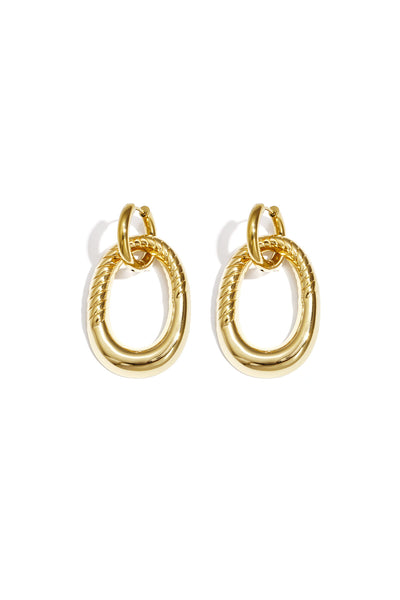
There are two basic forms: the classic tubular hoop (a curved tube) and the solid hoop (a solid or hollow metal ring). They hang differently: tubular hoops have more volume due to their tubular cross-section, while solid hoops appear flatter and more elegant.
Important for size assessment: the diameter of a hoop is measured at the outer edge. A hoop with a 25 mm outer diameter will therefore hang significantly further down than a hoop where the inner diameter is 25 mm. Reputable suppliers specify the outer diameter – ask if it is unclear what was measured.
Everyday size categories
The following categories have become established as a general guide:
Small (up to 15 mm outer diameter): Discreet and almost invisible. This size looks more like a stud earring from a distance. Good for professional environments, as a second or third piercing in an ear stack, or for people who hardly want to feel their jewelry.
Everyday size (15 to 25 mm): The most commonly purchased category. Visible, but not dominant. Hangs visibly below the earlobe without moving much when speaking. Suits almost every face shape and most clothing styles. Recommendation for the first gold hoop: 18 to 22 mm.
Medium (25 to 35 mm): A clear statement, but still suitable for everyday wear. This size moves when speaking, catches light, and is noticed. Good for anyone who uses jewelry as a means of expression – not just as an accessory.
Statement (from 35 mm): Dominant presence. These hoops set a look; they don't just frame it. For special occasions, evening styles, or people with a strong sense of positive attention. In everyday life, they can eventually become tiring – due to their weight and movement.
Face shape and hoop size
Face shape influences which hoop size looks most flattering – but with more leeway than with stud earrings, because hoops inherently have a balancing effect due to their circular geometry.
Round face: Larger hoops (20 to 30 mm) visually lengthen and create vertical lines. Very small hoops tend to emphasize roundness.
Angular face: The curved shape of hoop earrings is generally flattering because it counteracts the sharp lines of the face with curves. Medium sizes (18 to 28 mm) work very well.
Oval face: Almost any size works. The decision can then be based on style and occasion rather than face shape.
Long face: Rather medium to large hoops that occupy horizontal space and make the face appear visually wider.
Gold Hoops: What really matters with the material
Hoops come into direct and prolonged contact with the delicate tissue of the earlobe and the piercing channel. This makes the choice of material more important than for necklaces or bracelets.
Solid 585 or 750 yellow gold is the best everyday choice for hoops. Both are nickel-free in their alloy in Germany, skin-friendly, and do not lose their color. The disadvantage: real gold hoops in larger dimensions can be heavy – a relevant factor for sizes over 30 mm.
Gold-plated hoops (gold-plated silver or brass) look good initially. However, the gold plating wears off on the inside of the ring – precisely where the ring passes through the piercing. This is the spot that most frequently comes into contact with sensitive tissue. For people with nickel sensitivity, this can become problematic as soon as the gold plating wears off.
925 sterling silver is a good alternative for people who prefer cool metal tones. It is nickel-free and well tolerated by most people. Disadvantage: tarnishing, especially in contact with sweat and body care products.
Weight: An often underestimated factor
Hoop earrings can be heavy. Anyone who wears hoops daily will notice this after a few years: earlobes can stretch due to consistently wearing heavy hoops – an irreversible process. Therefore, there's more to lighter hoops than just wearing comfort.
As a guide: A solid 585 gold hoop with a 25 mm outer diameter and 2 mm tube width typically weighs 2.5 to 4 grams per piece. This sounds like little, but it's noticeable when worn daily and for many hours. From 5 grams per ear, the burden becomes uncomfortable for many wearers in the long run.
Hollow-formed or tubular hoops are lighter than solid, round hoops with the same visual impression. For large hoops, this is often more sensible – less burden with the same effect.
The Corelune earring collection includes 585 gold hoops, with outer diameter and weight specified for each piece. This allows you to estimate what to expect before ordering.
→ Further reading: Buying stud earrings: Which shape suits which face | Skin-friendly jewelry: What really helps
Frequent questions about hoops
How big are "normal" hoops?
The most commonly purchased everyday size is between 18 and 25 mm outer diameter. Within this range, hoops are suitable for most people and contexts. Statement hoops start at about 30 mm. Below 15 mm, hoops are so discreet that they look more like stud earrings.
Can hoops stretch the earlobes?
Yes, with long-term, daily wear of heavy hoops, a slight stretching of the earlobe is possible. The process is slow but irreversible. If you want to wear hoops daily: opt for lighter designs (tubular instead of solid hoops), prefer sizes up to 25 mm, occasionally remove them, and let your earlobes recover without hoops.
Which hoops for sensitive ears?
Solid 585 yellow gold or 925 sterling silver, both with no nickel content in the alloy. No gold-plated brass or alpaca. If unsure: check the fineness stamp. 585 or 925 directly on the hoop means legally regulated precious metal without nickel requirements.
How to wear hoops with ear-stacking?
Hoops as a second piercing: The hoop sits in the upper earlobe or in the helix area (cartilage rim). For ear-stacking: smaller hoop in the upper piercing (10 to 15 mm), larger in the lower earlobe piercing. This creates a size hierarchy and optical depth on the ear.