Buying Gemstone Rings: Which Stones Are Suitable for Rings – and Which Are Not
A gemstone ring is a different decision than a gemstone necklace. Rings are subject to wear and tear: they bump against table edges, come into contact with water and care products, and experience daily friction. A stone that hangs beautifully on a necklace can become dull, scratched, or even cracked on a ring within a year – if it is not suitable for such stress.
The question is not: "Which stone is the most beautiful?" The question is: "Which stone is beautiful enough and also durable?"
The Mohs Scale: The Most Important Criterion for Ring Gemstones
The Mohs hardness scale ranges from 1 (talc, can be scratched with a fingernail) to 10 (diamond, the hardest natural substance). For gemstones, it describes how resistant a stone is to scratches from everyday materials.
As a rule of thumb for rings: stones below Mohs 7 are not optimally suited for daily rings. Why 7? Because sand and household dust contain a high proportion of quartz, which has a Mohs hardness of 7. Any stone softer than quartz can be scratched by everyday dust particles.
This limit applies to daily wear. For rings that are only worn occasionally, the tolerance limit is softer.
Very Suitable for Rings: Stones Above Mohs 8
Diamond (Mohs 10): The hardest natural stone of all. Practically unscratchable by everyday materials. Perfect for everyday and wedding rings. Disadvantage: can chip if it directly hits harder surfaces with a sharp impact – hardness protects against scratches, not against impacts.
Ruby and Sapphire (Mohs 9): Both from the corundum family, almost as hard as diamond. Excellent for everyday rings. Ruby in its characteristic red shade, sapphire in classic blue, but also available in pink, yellow, orange, and green. Quality feature: uniform color distribution, good transparency.
Emerald (Mohs 7.5–8): Technically suitable for rings, but with a limitation: emeralds almost always contain natural inclusions (the so-called "Jardin"), which can be a weak point in case of strong impacts. Wearing emerald rings daily is possible – but with a little more caution than with ruby or sapphire.
Aquamarine and Topaz (Mohs 7.5–8): Well suited for rings. Aquamarine is robust, topaz as well – but topaz has a property called cleavage along an axis, which means: direct sharp impact can split it. Suitable for everyday wear, but it's better to remove it for intensive physical work.
Conditionally Suitable: Stones Around Mohs 7
Amethyst, Citrine, Rose Quartz (Mohs 7): All from the quartz family, right at the tolerance limit. Suitable for rings that are not worn daily and intensively. For daily wear over years, scratches will become visible. As an occasional ring or for people who do not wear gemstone rings in the household or during physical work: acceptable.
Tourmaline (Mohs 7–7.5): Just above the limit, suitable for rings with caution. The extraordinary color variety of tourmaline is a strong argument for it.
Not Suitable for Everyday Rings: Stones Below Mohs 7
Opal (Mohs 5.5–6.5): Beautiful, but not for daily worn rings. Opal contains water molecules in its structure, is hygroscopic (absorbs and releases moisture), and at Mohs 5.5 to 6.5, it is susceptible to scratches from everyday particles. As an occasional ring or pendant: very beautiful. As an everyday ring: not recommended.
Moonstone (Mohs 6–6.5): Similar situation to opal. The characteristic iridescence (adularescence) is unique, but the hardness does not easily withstand everyday wear. Much better suited as a pendant or a ring worn less frequently.
Pearl (Mohs 2.5–4.5): Pearls do not belong in everyday rings. They are organic, soft, and sensitive to acids, perfume, and sweat. As a ring for special occasions: very elegant. As an everyday ring: not suitable.
Setting and Protection: How Design Protects the Stone
The setting of a gemstone is not just aesthetic – it influences how well the stone is protected in daily life.
Prong Setting: Four or six metal claws hold the stone. The stone sits high and exposed – maximum light capture for brilliance, but also maximum exposure to impacts. Ideal for harder stones (diamond, sapphire, ruby), riskier for softer stones.
Bezel Setting: A metal ring completely encloses the stone. Very protective – the stone can only be damaged from above, the sides are secured. The better choice for more delicate stones or intensive daily use. Disadvantage: less light incidence, slightly less brilliance.
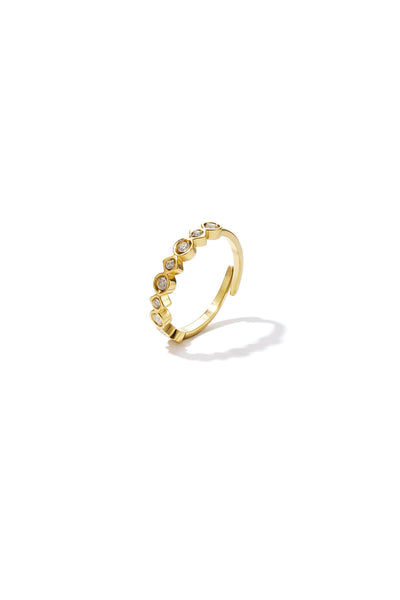
Pavé Setting: Many small stones set closely in a metal structure. Beautiful and intricate, but small setting prongs can give way over time. Regular inspection by a goldsmith is recommended.
At Corelune, you will find rings with gemstones in skin-friendly 585 gold, with clear stone specifications (type, treatment, origin if relevant) and solid settings for daily wear.
→ Further reading: Skin-friendly jewelry: What really helps | Recognizing real gold: 585, 750, or gold-plated?
Frequently Asked Questions about Gemstone Rings
Which gemstone is most suitable for everyday rings?
Diamond (Mohs 10), ruby, and sapphire (Mohs 9) are the most robust gemstones for everyday rings. Sapphires are particularly interesting because they are available in many colors (classically blue, but also pink, yellow, orange) and offer the robustness of a Mohs-9 stone.
Are treated gemstones worse than untreated ones?
Not per se. Most commercially sold gemstones are treated – heating for better color depth is standard for sapphires and rubies. Oil treatment for emeralds as well. This is industry-standard and accepted. Important: The seller should transparently disclose treatments. Untreated stones are rarer and more expensive, but not automatically more beautiful than well-treated ones.
How can I tell if a gemstone is real?
For the layman without a loupe: by price and material indication. A real sapphire of good quality in a ring costs from 100 to 300 Euros just for the stone. A blue stone for 15 Euros is glass or synthetic. A gemologist or goldsmith can check authenticity with a loupe and simple tests.
What are synthetic gemstones and are they bad?
Synthetic gemstones are lab-grown stones with an identical chemical composition and crystal structure to natural stones. A synthetic ruby is chemically a ruby – just without millions of years of geological history. They are cheaper, often more flawless, and ethically straightforward. No flaw – just a different origin. When purchasing, it must be explicitly stated: "synthetic" or "lab-grown."