Buying earrings: Which shape really suits your face
Earrings are the only piece of jewelry worn directly next to your face. Not on your neck, not on your wrist – but at eye level, framed by your features. This makes the choice of shape more important than for almost any other piece. An earring that matches your face shape will make you look more rested, balanced, and present. One that works against it will stand out – but not in the way you want.
This guide explains which earring shapes suit which face types, why this is the case, and which common mistakes are made when only buying what looks pretty.
The Basic Principle: Contrast flatters, Repetition emphasizes
Behind the face shape-earring theory lies a design principle that applies equally in architecture, fashion, and design: contrast creates balance. A round face appears more balanced with angular or edgy shapes because the earring introduces lines that the face itself does not have. A square face benefits from rounded shapes for the same reason.
Conversely: If a round earring is worn next to a round face, it emphasizes the roundness – there is no counterpoint. This can work if it is intended as a deliberate statement. However, as an unintended effect, it causes the face and jewelry to compete for the same statement instead of working together.
Round Face: Length and Verticality Create Proportion
A round face has almost equally wide and long proportions and soft, curved contours. What visually lengthens and structures it: shapes with vertical emphasis.
What works well: Dangles that are longer than they are wide – teardrop pendants, narrow rectangular shapes, geometric motifs with a clear vertical axis. For studs: Ovals worn vertically, or teardrop shapes. Structured, not overly rounded shapes.
What to avoid: Large round hoops, circular disc studs, sprawling spherical shapes. They repeat the roundness instead of countering it.
Oval Face: The Happiest Starting Point
The oval face is considered the most balanced proportion in terms of design: slightly longer than wide, with gently curved contours. There is almost no earring shape that doesn't work here – which, paradoxically, doesn't make the decision any easier.
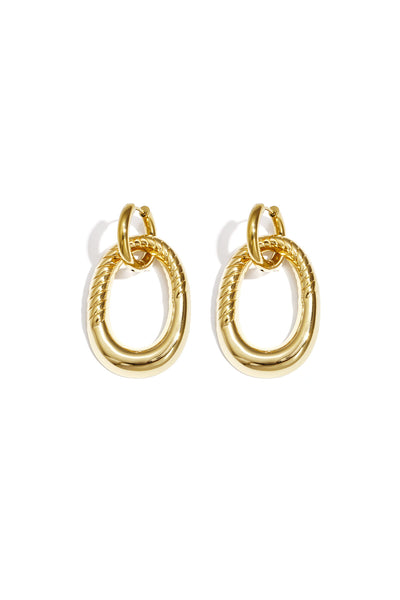
What works particularly well: Classic round or oval hoops in medium size (20 to 35 mm), simple geometric shapes, delicate teardrop earrings. The face also tolerates more unusual shapes and asymmetrical designs.
A guideline: For an oval face, it's worth taking your own personality and clothing style as a selection criterion more than the face shape. The face can wear almost anything – the question then is what should match the rest.
Square Face: Soft Shapes Soften Edges
A square face has a prominent forehead, striking cheekbones, and a broad, angular jawline. Structural strength, but little natural roundness. Shapes that flatter here bring warmth and curves into play.
What works well: Round studs, ovals, teardrop shapes with a curved finish, classic round hoops. All shapes that introduce curved lines and balance the geometric severity of the jaw and forehead area.
What works less well: Very angular, geometric studs – square shapes, triangular designs, edgy rectangles. They enhance the face's existing geometry instead of creating tension.
Heart-shaped Face: Width at the Bottom, Lightness at the Top
A heart-shaped face has a wide forehead and high cheekbones that taper down to a narrow chin. The goal of earring styling: visually create more width in the lower half of the face and avoid further emphasizing the forehead area.
What works well: Studs and small earrings that widen at the bottom – teardrop shapes, pear shapes, fan motifs. Also small, unobtrusive studs that do not bring the forehead area into the foreground.
What works less well: Very expansive studs at ear height – wide disc shapes or large round hoops that sit at forehead height and further emphasize the broad upper face area.
Long Face: Horizontal Lines Create Volume
A long face is significantly longer than it is wide, often with a high forehead and a narrow chin. What helps: horizontal elements that make the face appear visually wider.
What works well: Wide hoops, round studs with a larger diameter, short dangles with a wide element. Studs with a flat shape – round or oval – in diameters between 8 and 15 mm. Shapes that occupy more horizontal than vertical space.
What works less well: Long dangling earrings, narrow teardrop shapes, vertically oriented bars. They visually lengthen the face further, instead of balancing the natural length ratio.
Material and Size: The Second Level of Decision
→ Further reading: Skin-Friendly Jewelry for Sensitive Skin | Layering Necklaces: The Art of the Perfect Look
Frequently Asked Questions about Stud Earrings
What earring size is suitable for everyday wear?
For everyday wear, studs between 5 and 10 mm in diameter are recommended. Small enough not to interfere with work, large enough to be visible. From 12 mm upwards, it moves towards a statement piece – suitable for special occasions, but sometimes too prominent for intense daily wear.
Can I sleep with earrings on?
For newly pierced ears, piercing studios recommend wearing initial earrings for 6 to 8 weeks. After that: there's nothing wrong with sleeping with small, smooth studs. Long dangle earrings or hoops can bend or get caught on the pillow during sleep – it's better to remove them.
Are gold studs better for sensitive ears than silver?
Both metals are suitable for most people. The difference lies in the alloy: 585 yellow gold is typically nickel-free, as is 925 silver. For nickel allergies, yellow gold is the safer first choice, as some silver alloys can, in very rare cases, trigger other reactions.
What is the difference between a stud and a hoop?
Stud earrings sit directly on the earlobe and do not protrude. Hoops are ring-shaped earrings that pass through the piercing and hang as a ring on the ear. Hoops from 15 mm in diameter are considered more distinct, from 25 mm as statement hoops. Under 15 mm, they are subtle enough for almost any everyday context.